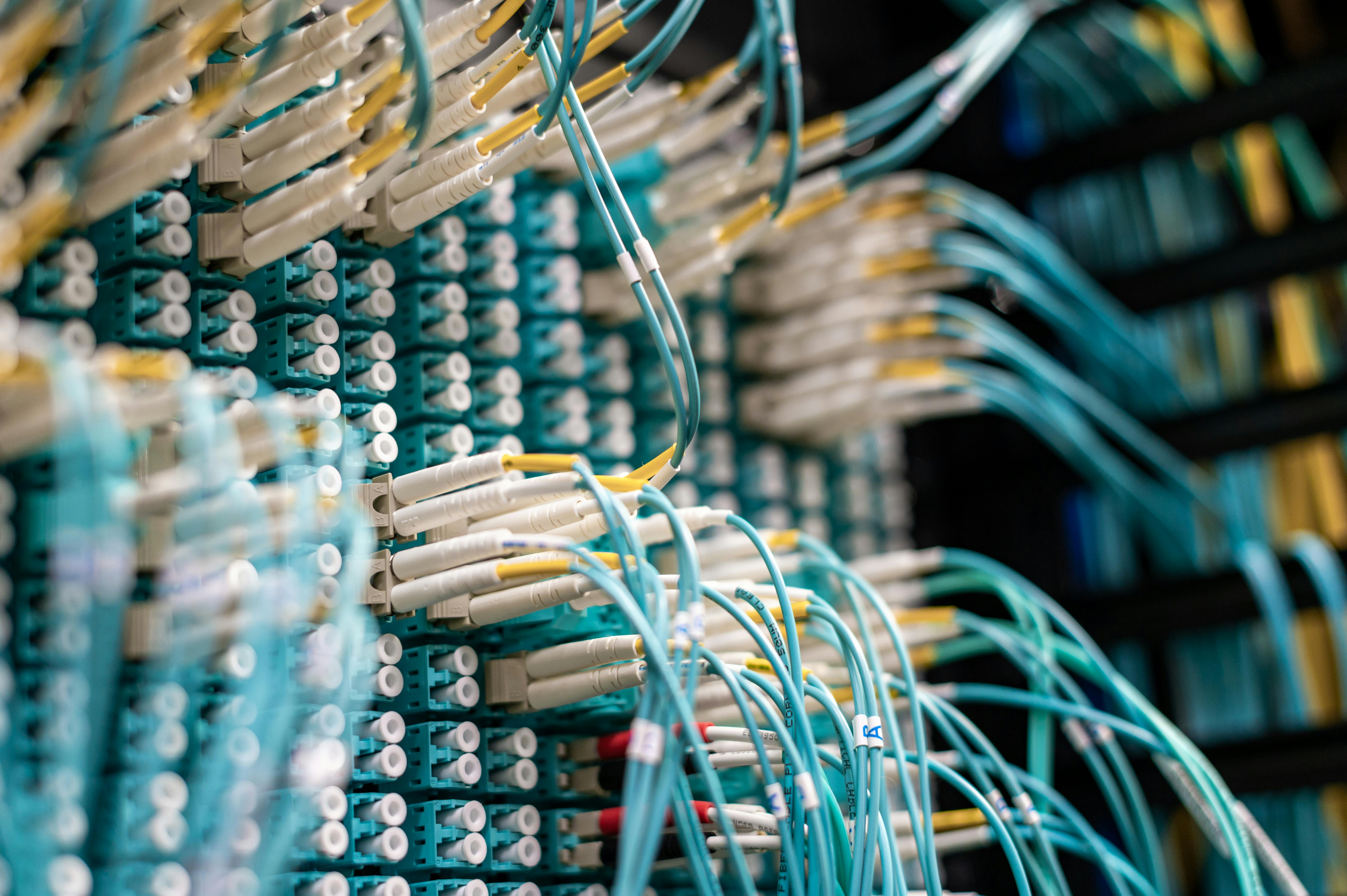
You have chosen a Dubai office, planned the network around Etisalat, and then discover a du label in the telecom cabinet. Or the property team says only du is available. It is natural to wonder whether you can use the existing fibre anyway, or whether you have to change provider.
The useful first step is to separate the service from the cable. The internet plan, provider network, building pathway, and final office termination are connected parts of a project, but they are not interchangeable. A fibre strand in the building does not automatically mean a particular provider can use it or activate a service on it.
What does “only du is available” mean?
It may mean the building or your specific unit has a recorded du connection and no available Etisalat order path. It could also mean the person checking has seen one outlet or one building record without checking the exact tower, floor, and suite with Etisalat. Address records can be inconsistent in multi-tenant developments, so a verbal answer is a starting point rather than a final technical survey.
Ask each provider a precise question: can this provider supply the service at this exact building, floor, and unit, and what physical delivery point does the provider require? Request the response and any next step in writing. That gives the property team and installer something concrete to coordinate against.
Why existing fibre is not automatically reusable
Fibre is a physical medium, but an installed link also has an owner, route, termination, records, and service configuration. A cable or panel labelled for one provider may be dedicated to that network or project. It may not be accessible, documented, or accepted for another service. Reconnecting it without authorization can create problems for the building and the operator.
There can also be separate infrastructure inside the building: the external carrier feed, a building backbone, and a tenant's private fibre link between rooms or floors. A strand in a riser might serve a building distribution point, not your suite. The label is useful evidence, but it cannot answer the serviceability question by itself.
Compare the choices using confirmed information
Before choosing a provider, compare the details that affect your day-to-day operation rather than relying on a brand preference alone:
- Provider-confirmed availability and the exact service address.
- The proposed connection type, handoff location, and installation dependencies.
- Written commercial terms, order status, and confirmed next steps.
- What the building permits for risers, telecom rooms, and office pathways.
- Your own requirements for upload, download, static addressing, voice, support, and backup.
Do not assume an alternate provider is automatically better or worse. Ask the business users and IT team what applications matter, then compare provider responses. If a deadline is close, request a realistic installation plan and explore an interim connection separately from the permanent fibre decision.
Who handles a new route?
If Etisalat confirms a service can be provided but the physical route to the unit is missing, the next step may involve building permission, a route survey, and provider-approved installation work. The route might use an existing duct or require a different approved pathway. A fibre contractor can inspect and complete agreed physical work; the provider controls its service order, acceptance, and activation.
SAS IT Services is an authorized Etisalat partner for agreed Etisalat fibre installation. SAS also undertakes third-party installation work for du-related projects and does not claim du authorization or affiliation. For either scope, access and approvals from the relevant property and provider remain important.
Practical next steps for a Dubai tenant
- Ask Etisalat to check your complete address and confirm the required service endpoint.
- Ask du for the same address-level check if you are comparing options.
- Get the building manager's contact for the telecom room and approved contractor process.
- Have the physical route from the building distribution point to the office inspected.
- Keep the provider order, approvals, physical works, and service activation as separate milestones.
How SAS IT Services helps
Our Dubai fibre cable pulling and splicing service can cover route inspection, approved cable pulling, splicing, termination, labeling, and testing within the agreed project scope. We can help identify physical constraints and coordinate with the customer, building team, and provider; we cannot promise another operator will accept or activate a cable.
If your office also needs a private link between floors or a network handoff after the carrier point, our office network services can help scope the LAN side. For office planning context, visit IT infrastructure setup or the SAS IT Services Dubai homepage.
Frequently asked questions
Can Etisalat use a du fibre cable already in my Dubai office?
Do not assume that it can. The existing cable and termination may be dedicated to another provider or project and may not be approved for reuse. Ask Etisalat and building management to confirm the required route, ownership, permissions, and endpoint before any work is arranged.
Does a du fibre outlet prove that Etisalat is unavailable?
No. An outlet shows that a physical termination exists, but it does not by itself determine which services can be ordered at the address. Ask each provider to check the exact building, floor, and unit against its service records.
Can SAS install Etisalat fibre in an office that has du infrastructure?
SAS IT Services is an authorized Etisalat partner for agreed Etisalat fibre installation work. Any new route must follow the provider's work scope and building permissions. SAS does not claim du authorization or affiliation when working on du-related projects as a third-party installer.
Should I choose the available provider to meet my office opening date?
Compare confirmed service availability, commercial terms, technical requirements, and the date each provider can actually activate service. Do not base a decision only on a visible cable or an informal estimate. Ask the provider for a written status and plan a temporary option if appropriate.
Can a technician tell me which provider can activate my service?
A fibre installer can assess cable routes and physical work, but only the provider can confirm its service availability, order status, activation, and acceptance requirements. WhatsApp SAS at +971 58 539 7453 for a physical route assessment in Dubai.
Provider choice is a service decision; a labelled cable is only one clue about the building's physical route.
Need the route checked? WhatsApp SAS IT Services at +971 58 539 7453 with your building, suite, preferred provider, and any route photos you are permitted to share.
Related reading: What to check when Etisalat fibre is not available in a rented office.